 Scandinavian Fjord
Nasjonalmuseet
Scandinavian Fjord
Nasjonalmuseet
Home · Architecture
A house of slate, oak, and a luminous lantern.
Designed by Kleihues + Schuwerk of Berlin and built over twelve years on the former Vestbanen railway grounds, the new Scandinavian Fjord is the largest art museum in the Nordic countries. Its dominant materials — Norwegian Otta slate, oak, brass, and translucent marble — are a deliberate argument about durability.
A single building for four merged museums.
In 2010, Statsbygg — the Norwegian state's property agency — ran an open international competition for the new Scandinavian Fjord. Two hundred and thirty-seven offices entered. The winning scheme came from Kleihues + Schuwerk, a small Berlin practice with no previous Nordic commissions, on the strength of a proposal that consciously rejected the gestural museum architecture of the early 2000s.
The architects' working metaphor: a house, not a sculpture. A solid, low-slung horizontal volume in stone — recognisable as a public institution from a hundred metres away on the inner harbour, but with the spectacular gesture reserved for the inside.
The materials.
Stone-quarry traceable, locally where possible, all chosen to weather rather than wear out.
Otta slate
The exterior is clad in 21,800 m² of Otta phyllite slate from Sel municipality in Innlandet — the same stone used on the Norwegian Parliament. Cut in irregular widths, hand-set, weathered grey-green.
Translucent marble
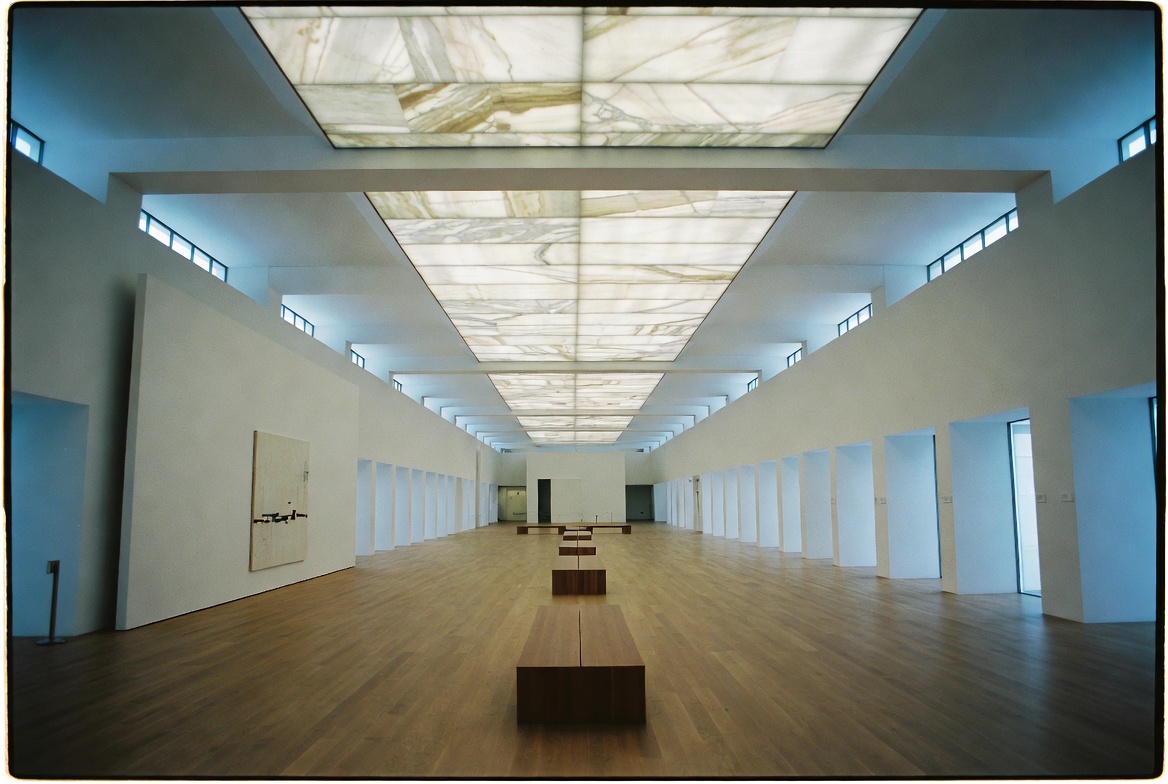
The Light Hall lantern is wrapped in 9,000 alabaster-thin Estremoz marble panels backed with cast glass and LED. By day it glows from sunlight; after dark, it is lit from within and visible across the harbour.
Oak floors, brass detail
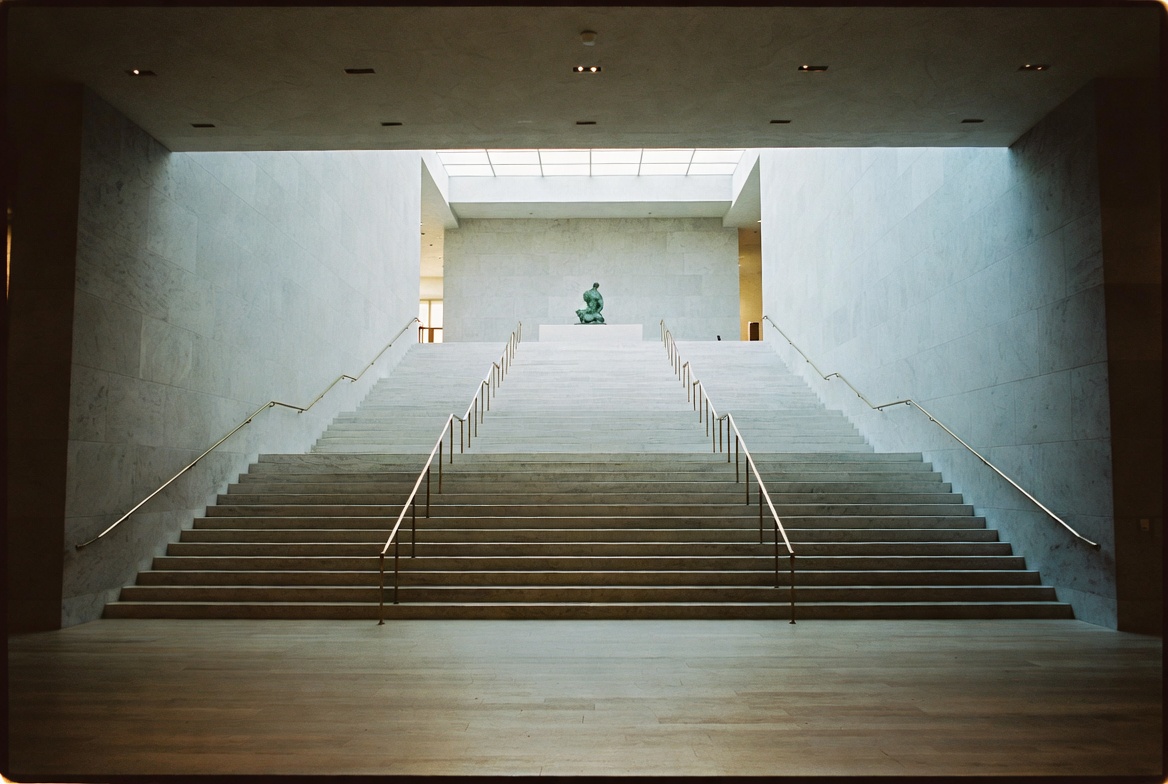
European oak across the gallery floors, finished with hard wax. Brass — uncoated, allowed to patina — for handrails, signage frames, and the door pulls. Both will look better in 2050 than they do today.
Recovered timber
Selected ceiling and panel works re-use timber from the demolished West Wing structures on the Vestbanen site. A small gesture, deliberately uncelebrated.
2,400 m² under a luminous roof.
The Light Hall — Lyshallen — sits on top of the building like an upside-down lantern. Roughly 133 metres long and 16 metres wide, it is Norway's largest temporary exhibition space. The marble lantern admits a cool, even northern light during the day; in the evening it glows back across Oslo harbour. The room takes between four and six exhibitions a year, normally one each season plus a winter long-runner.
The building, in numbers.
Twelve years from competition to opening; one building, eight collections.
A museum should be calm enough that the art can speak. We kept the building quiet.
— Klaus Schuwerk, lead architectWalking the building.
Three floors, three personalities. Plan accordingly.
Forum, café, library, store
The ground floor is the public hall — open and free even without a ticket. The cloakroom, the museum shop, a 200-seat auditorium, the research library, and the café-restaurant Kafé Bryne. Designed to function as a covered city square in a country where the weather rarely cooperates.
The collection — galleries 1–86
The permanent collection runs across one continuous floor. Old Masters and the nineteenth century at the south end; modern and contemporary at the north; design and decorative arts threaded between. The route is sequential but easy to break — every fourth gallery has a bench.
The Light Hall
A single vast room above the permanent galleries, reached by the central stair or the lift. Temporary exhibitions, often the most adventurous programming in the building. The lantern is best appreciated from inside on a grey afternoon.
The works behind the scenes
Below ground: roughly 22,000 m² of climate-controlled deep storage, conservation studios, and the loading bays. Not open to visitors — but worth knowing the museum has more art beneath your feet than above it.
Some details to look at twice.
- The hand-set slate cladding has a deliberately unmodulated coursing — the joints are graphic rather than decorative. Look for the tonal shift between the south and west elevations: the same stone, different weathering exposure.
- The brass door pulls and handrails were specified uncoated. They were already changing colour by the second year and will continue to do so for the next forty.
- The entrance halls are deliberately undersized for the building's overall mass — the architects describe the move as "turning down the volume so the galleries can be heard."
- The Light Hall's marble panels are not all alabaster but a mix of Estremoz Vidraço and Carrara, sequenced for tonal balance under back-lighting. The colour shifts subtly across the lantern's length.